
There’s a Bizarre Vikings Controversy

In 2024 and 2025, the Minnesota Vikings were among the top spenders in free agency, acquiring numerous expensive athletes. This year, it seems to be time to pay the price, as the club has gotten rid of some lucrative contracts via trade and roster cuts.
That reduction in spending has prompted Pioneer Press’ Charley Walters to suggest that the Vikings might be for sale sooner rather than later.
Of course, that idea has made some waves, as it came out of the blue.
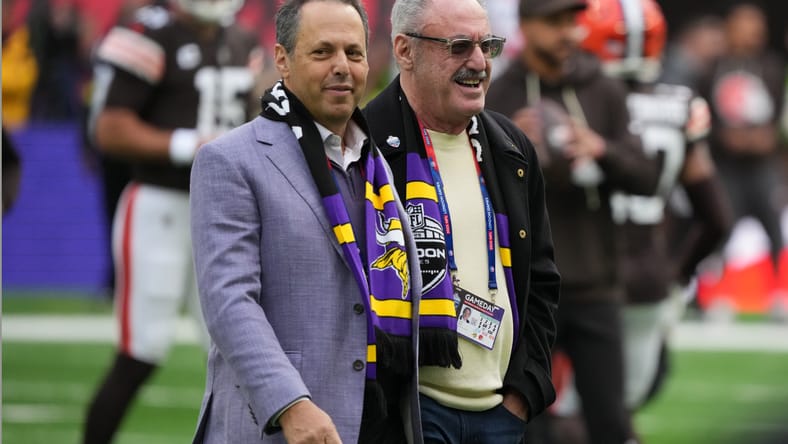
He wrote, “It’s beginning to look as if Vikings ownership now could be mirroring Twins ownership, which has sought to sell its team. Figuring they were championship worthy, the Vikings a year ago spent more money on player payroll in the offseason ($350 million) than any of the NFL’s other 31 teams.”
Last year’s additions, Javon Hargrave and Jonathan Allen, were released in March and replaced in April’s draft. Jonathan Greenard was traded to Philadelphia, further reducing the payroll.
“This offseason, the Vikings have spent just $226 million, second lowest in the league. It appears Vikings owners Mark and Zygi Wilf have decided on a significant payroll slash this year. The Vikings won’t admit it, but this sure looks like a rebuilding year. This is the 21st year the Wilfs have owned the Vikings. Until this year, they have made a commendable attempt at winning the Lombardi Trophy.”
The Twins’ ownership has been criticized for refusing to open the checkbook to build a competitive squad. The Vikings, meanwhile, have certainly invested over the years, both in the roster and in a new stadium and a state-of-the-art facility in Eagan, MN.
This year, though, the Vikings had to make some moves to get under the salary cap in time for free agency and that decision was made easier by the fact that the operation appears to be farther away from a Super Bowl than expected a year ago. The J.J. McCarthy bet hasn’t been won so far and without a quarterback, it’s hard to play meaningful football in January.
Still, they added Kyler Murray, a move that nobody would make if they didn’t believe the team could cause some damage in the upcoming season.
Walters continued, “Meanwhile, the Twins’ Pohlad ownership isn’t unlike what Red McCombs did with the Vikings in 2005 before selling to the Wilfs. McCombs, who bought the Vikings for $246 million in 1998, cut player and coaching staff payroll to a bare minimum and waited until he got his price ($600 million) from the Wilfs. If the Wilfs, who curiously still haven’t named a permanent general manager since firing Kwesi Adofo-Mensah last January, were to sell the Vikings today, they could get between $8 billion and $9 billion.”
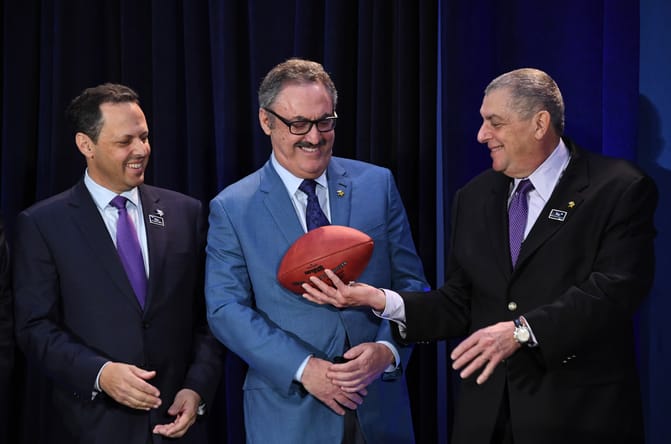
Indeed, they could make some nice cash by selling the organization, but that doesn’t appear to be the plan whatsoever.
Ben Goessling of the Star Tribune posted on social media, “A source close to the Wilfs said there’s “zero truth” to the notion the #Vikings owners are thinking about selling the team. They’ve long talked about the team staying in the family for multiple generations, and both Mark and Zygi Wilf’s kids have taken on larger roles with the team in recent years.”
It’s fair to criticize ownership, of course, but the notion that the Wilf family hasn’t spent money over the years is an unjustified claim. In fact, the ownership group has been praised for taking care of players and paying those who have earned it. The recent Greenard deal is a rare sidestep from that strategy.
Mike Florio of Pro Football Talk commented on the situation, “While no one will objectively conclude that the Minnesota roster screams out ‘Super Bowl contender’ for 2026, the spending decisions don’t immediately point to a potential sale of the team. Still, perception is reality. With the hypothesis morphing into the beginnings of a theory, it could be time for the Wilfs to make the case publicly that they aren’t getting ready to pound a ‘For Sale’ sign in the front yard.”
After two years of massively spending in free agency, the franchise had to clear its books at some point. Paying more in cash than is counted against the salary cap is not a sustainable approach. The alternative was to kick the proverbial can down the road, but without obvious championship aspirations, it made sense to use 2026 to pay for some past sins, while preparing the salary cap for investments in future years.
It should be noted that they haven’t blown up the roster by any means and it doesn’t look bad at all on paper.
The Wilf family has been in charge since 2005 and there’s no reason to believe that will change anytime soon.