
Bill Belichick Snub, Pro Bowl Controversies Fuel NFL Honors Debate

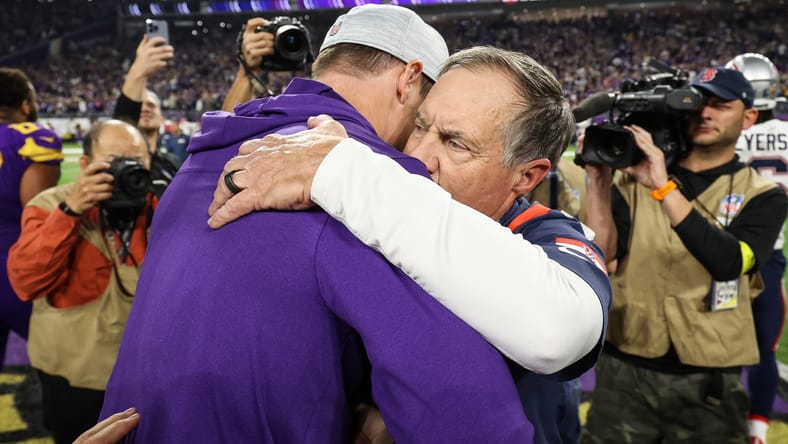
The NFL is once again finding itself needing to defend the credibility of its honors system. From Pro Bowl selections that feel disconnected from performance to renewed confusion around the Hall of Fame process, the league’s honors are facing renewed scrutiny. This is not just confusing to us as Vikings fans, but players and analysts alike are asking an uncomfortable question: Do these NFL honors still reflect football excellence, or have they become exercises in optics and popularity?
The Hall of Fame Bill Belichick Debacle
Few names come to mind of “Coaching Royalty” in NFL history, and certainly, all of them should include Bill Belichick. Even as a Vikings fan who dislikes the Patriots, I can clearly see he is at the top of the coaching pyramid.

Reports surfaced that, indeed, Belichick is not an automatic first-ballot Hall of Fame inductee, has lit social media and talk shows on fire. Resume-wise, there is no modern coach — and arguably no coach in league history — who matches his career achievements as a head coach.
Belichick’s coaching résumé speaks for itself:
- Career record: 302 regular-season wins, second all-time among head coaches (Don Shula is 1st with 328)
- Division titles: 17 AFC East championships (Most division titles in NFL History, Don Shula is 2nd with 14)
- Playoff record: 31–13, the most postseason wins in NFL history as a head coach
- Super Bowls: 6 championships as a head coach (9 total, including his assistant years). Belichick’s 6 Super Bowl wins are the most in NFL history, with Chuck Noll having 4.
- Conference titles: 9 Wins resulting in Super Bowl appearances.
Stacked against legends like Don Shula, Vince Lombardi, Chuck Noll, or Bill Walsh, Belichick’s case for the greatest head coach in NFL history is not only superior but blows the competition away.
That is what makes even the idea of him falling short in Hall of Fame voting so troubling. The Pro Football Hall of Fame selection process relies on a 50-member media-based voting body, with candidates requiring 80% approval. Although debating who is the best head coach ever is worth having, the exclusion of Bill Belichick in his 1st eligible year for the Hall of Fame is difficult to justify.
He is, without a doubt, the most accomplished head coach in NFL history. Not admitting him on a first ballot raises serious questions about how the Hall of Fame process is being applied. Whether you like Bill or not is irrelevant, and clearly that is what affected him from achieving the 40 of the 50 votes needed to get into the Hall of Fame.
Patriots owner Robert Kraft and Tom Brady made comments in Bill’s defense, and Brady hinted at the hypocrisy and suggested that popularity played a role in Bill’s admission to the Hall of Fame.
How Hall of Fame Selections Are Supposed to Work
In theory, the Hall of Fame is about impact, achievement, and historical significance. Voters are tasked with evaluating a candidate’s full body of work, not recency bias, personal feelings, or off-field optics. First-ballot induction is meant to signify a player or coach whose credentials leave no reasonable doubt. That definition should be a slam dunk in terms of Bill Belichick. I don’t believe that other than the soon-to-be-eligible QB, Tom Brady, there is anyone in NFL history who fits that description more than Bill Belichick.
Even with the Bill Belichick leak, there still haven’t been any results for other finalists of the 15 considered for the Hall of Fame, including Vikings’ former defensive lineman Kevin Williams, who awaits the decision of voters as well this year. Williams was famously teammates with Pat Williams. Together, they formed the “Williams Wall” and stymied offenses for years. As a huge Kevin Williams fan, I hope his 6 Pro Bowls, 5 All-Pro Selections, 2000s All-Decade Team Selection, and 63 sacks in his 13 NFL seasons (11 with Minnesota) are enough to push him through.
Now the Pro Football Hall of Fame has recently come out with a news release that also suggests that voters may have violated the bylaws, and if found to have done so, could be removed from the committee. This alone only validates my argument and that of many others voicing what seems to be a clear injustice in terms of Bill Belichick.
The Pro Bowl: From Honor to Head-Scratcher
Those same concerns with the Hall of Fame are even more evident in the Pro Bowl, which has undergone a steady decline in prestige over the years and is no longer an actual NFL game.
Once viewed as a benchmark of elite performers in a season, the Pro Bowl is now determined by a three-way vote among fans, players, and coaches. The current system rewards big names, market size, and social media impact over a player’s actual stats and impact on the field. Each year, it seems we see increasing amounts of “opt-outs” of the Pro Bowl and selecting less deserving alternates that only further dilute the meaning of the selection. Why do fans want to watch a sub-par product that is falsely advertised as being the best of both conferences?
The Shedeur Sanders Selection Controversy

That brings us to Shedeur Sanders being selected in 2025. Nothing illustrates that shift more clearly than the controversy over a rookie quarterback earning Pro Bowl recognition over several more deserving quarterbacks.
Sanders’ selection was widely attributed to fan voting and popularity with the media more than the statistical performance by a large margin. While his rookie season showed some promise, he flat-out was not the next in line to be selected in terms of play on the field over more deserving quarterbacks. This also affects some of these players, who have monetary incentives that kick in if they are selected.
The Pro Bowl has increasingly become a popularity contest rather than selecting the best players, and Sanders’ selection is a pretty glaring indictment of the Pro Bowl’s relevance and meaning.
Kicker Confusion: Pro Bowl vs. All-Pro

The disconnect becomes even harder to justify when comparing Pro Bowl and All-Pro honors.
This season, Dallas Cowboys kicker Brandon Aubrey was selected as the NFC Pro Bowl representative, while Minnesota Vikings kicker Will Reichard, who was statistically superior in key categories such as field-goal percentage, distance consistency, and total points, was snubbed. Reichard was later named an All-Pro Selection over Aubrey, which only proves my point about the voting issues in the NFL’s current system, in which we as Vikings fans saw deserving players on our squad get snubbed.
That contradiction raises a glaring question:
How can one player be recognized by experts as the best at his position as a first team “All-Pro”, yet not even make the Pro Bowl?
The answer is due to the voting mechanics. All-Pro teams are selected strictly by media members evaluating on-field performance. The Pro Bowl takes popularity and reputation into account, which has to be frustrating for players even more than for fans. Some of these players have those bonuses in their contracts, and probably deserved to be selected, and the difference between Aubrey and Reichard may be slim and arguable, but the selection of Shadeur Sanders with an 18.9 QBR that ranks him at the bottom of the NFL, not only in 2025, but in the bottom 5 of 696 qualified QBs since 2006.
A Broken Voting System
Individually, each of these cases can be explained, but collectively they point to a deeper issue. The foundation and meaning of these honors are weakened when the mechanisms meant to preserve excellence instead generate confusion.
At some point, the league must decide whether these awards are meant to celebrate and select the best in the NFL, or simply an obligation to continue appeasing the politics of popularity and the money machine. The systems in place no longer appear to be consistently achieving their intended goal of recognizing the league’s best performers. The recent press release from the Pro Football Hall of Fame is a step in the right direction to address it.
