
The Vikings’ Dead Money is Soon to Swell

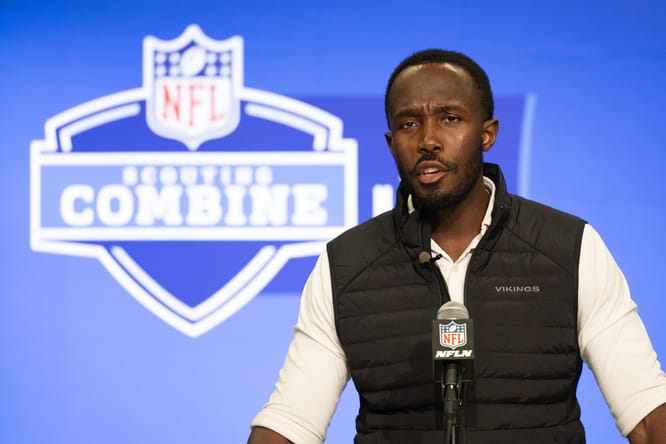
The Vikings’ dead money isn’t too cumbersome. In the coming weeks, that reality appears likely to change.
GM Kwesi Adofo-Mensah sees a touch beyond $5.6 million chewed up as dead money, per the current estimate on Over the Cap. Being able to clear out the monstrous debt pile — currently around $49 million in the red — means seeing more of the budget immobilized due to dead money flowing over from cuts and/or trades that have yet to arrive.
The Vikings’ Dead Money in 2026
For the sake of argument, assume that starting center Ryan Kelly gets cut.
The issue with the veteran isn’t that he’s a bad football player. Quite the opposite is true; he’s very, very good. The great issue is that he’s climbing into his 30s and is coming off a season where he worked through multiple concussions. Cutting him involves recouping more than $8.3 million in cap space. Left behind as dead money is $3,367,500.
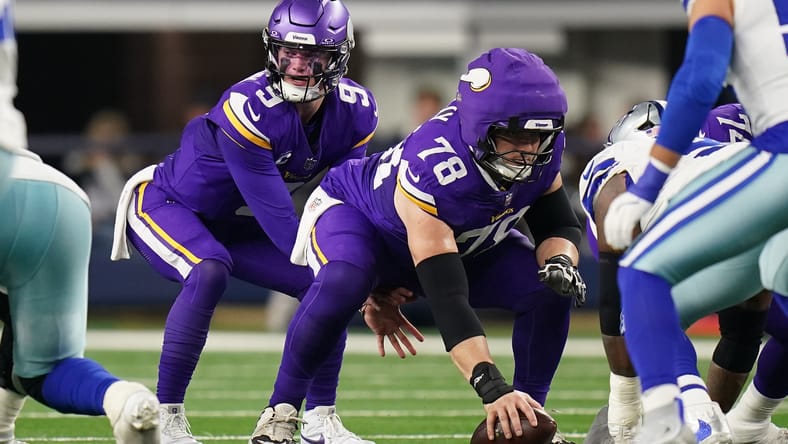
Keeping things simple would involve adding that Kelly dead money onto the current amount for a $9 million total. Move forward with some of the other cut candidates. How much gets left behind due to straightforward cuts? Check it out:
- DT Javon Hargrave: $10,497,500
- TE T.J. Hockenson: $12,425,000
- RB Aaron Jones: $6,800,000
Again, keep the numbers simple. Those three cuts — all plausible, though with some pain in each instance — would mean accepting about $30 million.
Keep in mind, folks, that the NFL’s normally malleable salary cap isn’t so when it comes to dead money. Once the number arrives, it becomes immovable. All that can be done is to burn it off.

Of course, that’s not to say that there aren’t options in the present moment for the Vikings.
Trades, for instance, can often clear out more cap space. The signing bonus portion of the contract will stick around in Minnesota no matter what. The acquiring team, though, would be accepting the player alongside the player’s guaranteed money, meaning it’s open money for Minnesota.
Trading Hargrave would mean mean seeing less than $6.5 million staying back as dead money (as an example).
There’s then the option to designate the cut as occurring in a post-June 1 manner. Two issues arise in that instance. For starters, a team only walks into that open cap room after June 1st. There’s then the reality of still needing to digest the dead money; the semblance of savings arrives due to the money getting divided between the 2026 and 2027 budgets.
These twin realities don’t nullify post-June 1st cuts as a viable option in Minnesota. Rather, they add some context that aim to clarify that there’s a cost to the approach.
Kwesi Adofo-Mensah is a numbers nerd. Prior to getting into the NFL, the GM pursued an academic path before then getting into investing. Numbers are his thing, so he’ll understand what’s needed to get the financial portion of things sorted out.
The Vikings are likely moving into a 2026 where there will be somewhere around $30-$35 million in dead money.
