
The Vikings’ Jonathan Greenard Cap Charge Now Sits in an Uncomfortable Spot

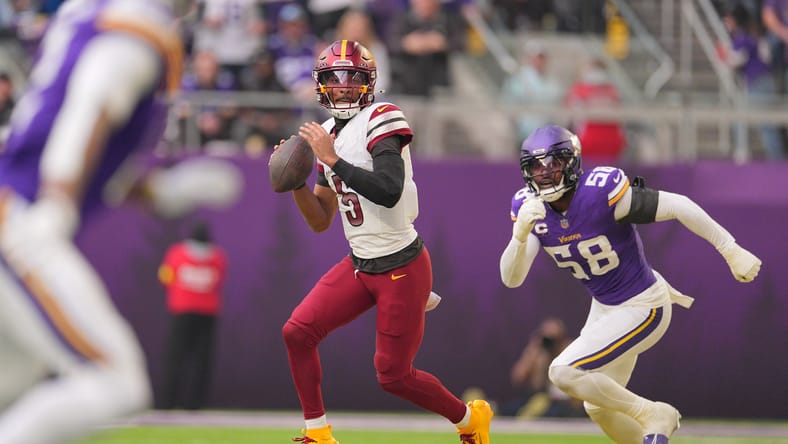
During the 2026 NFL Draft, the Minnesota Vikings finally decided to pull off a long-rumored move: trading Jonathan Greenard. Doing so came from within the context of the veteran coming off a poor season but wanting a raise (for good reason).
So, the decision was for a mutually-beneficial breakup.
Philadelphia brought the defender to town for the cost of a pair of 3rd-Round selections. Helping to balance out the trade was a 7th going over to the Eagles alongside the pass rusher. After becoming an Eagle, Greenard landed his pay raise, tacking on a couple more years to his deal. That’s where things get fascinating.
Jonathan Greenard’s Cap Charges
To leave Houston behind for Minnesota back in 2024, Greenard put pen to paper on a four-year contract sitting at $76 million.
— READ MORE: Jonathan Greenard Isn’t Done Helping the Vikings —
— READ MORE: The Vikings’ Cap Boost is Now Showing Up on the Horizon —
— READ MORE: Vikings See Veteran Pass Rusher Stolen Away from NFL FA —
— READ MORE: Yet Again, A Former Vikings Passer Has Been Fired —
Pretty quickly, the defender proved to be a bargain, so much so that he needed a contract adjustment. His great issue was that he’s coming off a 2025 where he had just 3 sacks, in no small part due to injury issues. Worse yet, the Vikings don’t have a pile of open cap space, creating some hesitancy to commit too much to an older player coming off underperformance and injury.

Those basic details make a trade with the Eagles quite reasonable. What may arrive as a touch disappointing and confusing for some is that Minnesota is carrying a larger cap charge for Greenard in 2026.
Consider a side-by-side look at the cap charges (shout out to Over the Cap):
| PHI’s Greenard Cap Charge | MIN’s Greenard Cap Charge |
| 2026: $6,278,000 | 2026: $9,900,000 |
| 2027: $11,139,000 | 2027: $0 |
| 2028: $15,796,000 | 2028: $0 |
| 2029: $20,204,000 | 2029: $0 |
| 2030: $44,433,000 | 2030: $0 |
As per usual, Eagles GM Howie Roseman has decided to be aggressive. That approach manifested itself within the initial decision to acquire Jonathan Greenard. Next, there was the decision to rework Greenard’s deal, turning a couple of seasons at $38 million in promised pay to four years for $98 million. Part of the update therefore means seeing a two-year deal that averaged $19 million bumped up to a four-year deal averaging $24 million.
So, a nice pay bump for Jonathan Greenard, though it’s one that Minnesota could have afforded had there been a desire to do so.
Circle that 2026 cap charge. The EDGE1 is costing a mere fraction of what he’s worth if we shrink the perspective down to just the current year. Even the upcoming cap charges are incredibly modest, the byproduct of Roseman kicking that monstrous dead money pile into 2030 via bonus proration.
Essentially, Philadelphia has chosen short-term gain at the cost of long-term pain. The Vikings have done the opposite, choosing short-term pain in the name of long-term gain. As a result, the winner in 2026 is quite clear.
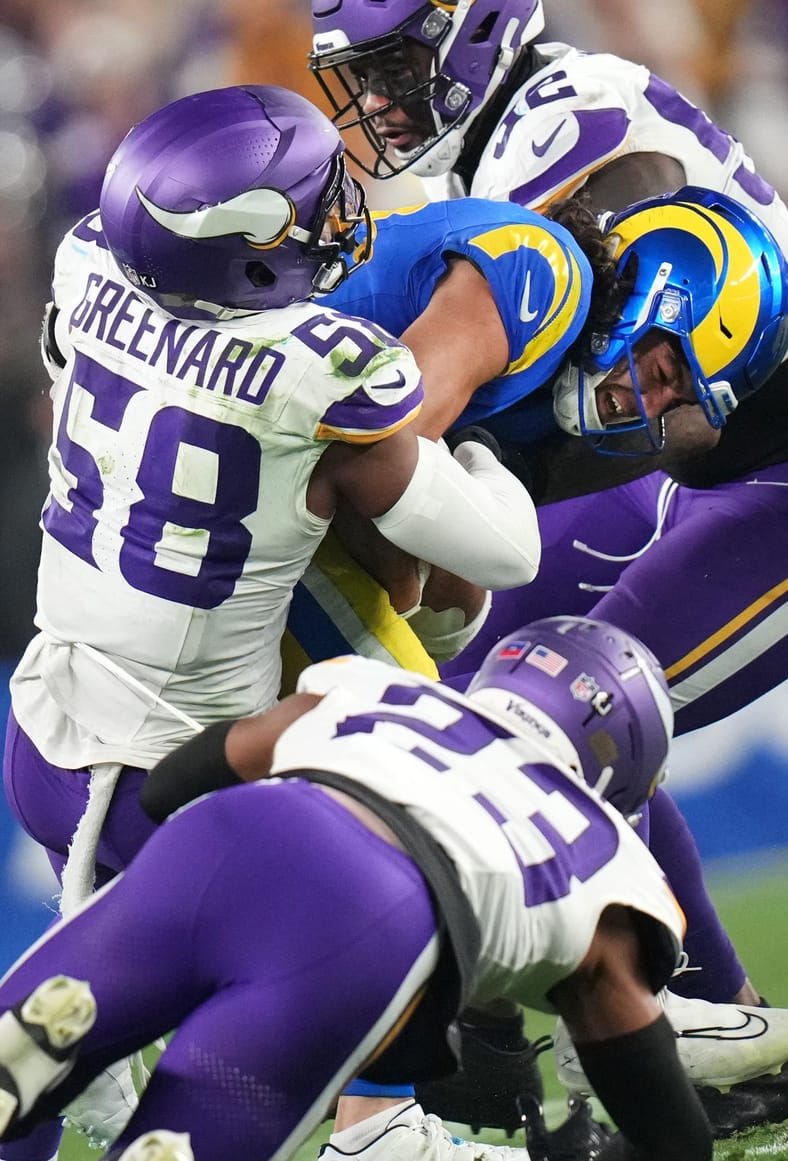
Mike Florio writes of the deal before concluding that keeping Jonathan Greenard could have worked: “the Vikings likely could have kept Greenard under contract for the next two years by increasing his pay from $38 million to $50 million, and by guaranteeing all of it in full at signing. The extra two years, at $48 million, could have been added at no immediate cost to the Vikings, allowing them to move on after 2027, if they decided to do so.”
Further from Florio: “That fact will prompt some to wonder why the Vikings didn’t just increase his pay to $50 million over the next two years, from $38 million. Given that the market for pass rushers has increased to $50 million per year, it’s not an unreasonable question to ask.”
Of course, an exclusive focus on 2026 (and 2027, for that matter) misses the mark, at least to a certain extent. Yes, the Vikings are digesting a dead money cap charge that’s ugly — a touch below $10 million — but so much of the motivation for the trade was to better position the franchise for the future.
So, too, is there an apparent desire to turn things over to Dallas Turner alongside some desire to add those 3rd-Round picks. A future where Turner shines (for cheap) and at least a single 3rd gets sunk into a very good player makes the move easier to understand even if the cap wasn’t an impossible riddle.

Jonathan Greenard will turn 29 in May. He stands at 6’3″ and is roughly 260 pounds. Being healthy and playing well means that he’s a Pro Bowl talent who may demand fringe All Pro attention.
The Vikings and Eagles don’t play in 2026, but the playoffs could change that reality.
