
The Vikings’ Front Office Can’t Have a Normal Draft

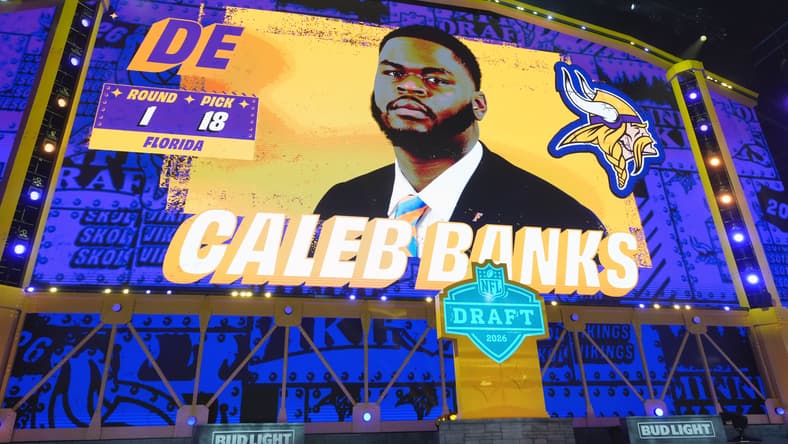
Once again, the Vikings have drawn the mockery of the NFL world with a head-scratching 1st draft pick.
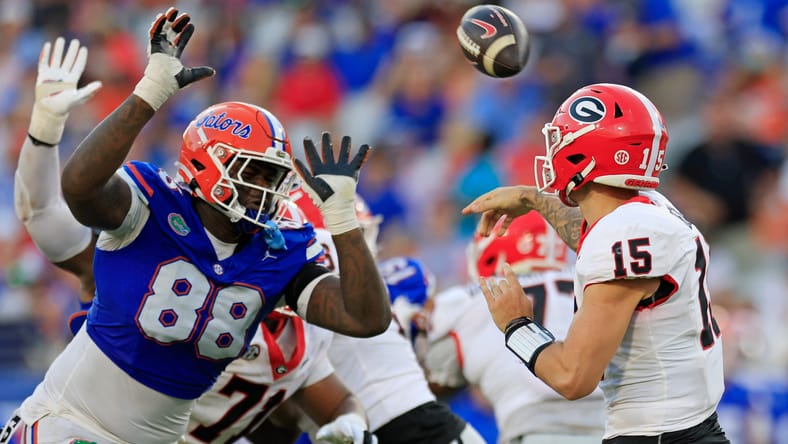
With the 18th pick, Minnesota selected DL Caleb Banks, a player with undeniable physical ability yet a recurring foot injury that hampered his last season at the University of Florida. Banks’s size makes him a threat against the run game; he also has potential as a pass-rusher, but so far that potential hasn’t led to significant production on the field. As a result, Banks was way down at 37 on Arif Hasan’s consensus big board. ESPN’s Mel Kiper had Banks at 62 in his pre-draft player rankings.
The consensus, then, is that the Vikings massively overreached on Banks, with many analysts giving the Vikings the lowest grade of any team after round 1. Even if the Vikings really liked Banks, the discrepancy between his draft pick and consensus board ranking strongly suggests that the Vikings could have traded down and still landed the big defensive lineman.
Sometimes, a team might desire a trade down but simply be unable to find a willing trade partner. In this case, however, the Vikings have no such excuse: just two picks later, the Philadelphia Eagles traded picks 23, 114, and 137 to their rival Dallas Cowboys to move up to 20 for WR Makai Lemon. (The Cowboys also sent a 2027 7th-round pick to Philadelphia in the trade.) Almost surely, the Eagles would have been willing to make a similar trade with the Vikings to move up to 18.
Indeed, let’s suppose that the Vikings had traded pick 18 to the Eagles for 23, 114, and 137. The table below shows how that trade would look on the Rich Hill, Fitzgerald-Spielberger, and Ben Baldwin trade value charts:
| Point Value | |||
| Vikings receive: | Rich Hill | Fitz-Spiel | Baldwin |
| 23 | 760 | 1411 | 90 |
| 114 | 66 | 600 | 27 |
| 137 | 37.5 | 507 | 20 |
| Eagles receive: | |||
| 18 | 900 | 1535 | 97 |
| Difference | -36.5 | 983 | 40 |
| Pick equivalent | Late 3rd | Mid-late 2nd | Mid-late 3rd |
The Rich Hill chart, which measures market value based on previous trades, favors the Eagles quite heavily. This shows that, if anything, our trade scenario is quite conservative: the Vikings likely could have squeezed even more out of a trade with the Eagles. However, even in this conservative scenario, the player-value-based Fitz-Spiel and Baldwin charts give Minnesota the advantage, with the excess value falling somewhere between a late-2nd- and late-3rd-round pick.
Even that is likely too conservative: it is probable that the Vikings could have traded back to 23 and still drafted “their guy” Banks, picking up two fourth-round picks in the process. The table below shows the added value from just the 114th and 137th picks on the three draft value charts:
| Surplus picks alone | 103.5 | 1107 | 47 |
| Pick equivalent | Mid-late 2nd | Early-mid 2nd | Mid-late 2nd |
The charts are unanimous: just a modest trade down to 23 before selecting Banks would have netted the Vikings the equivalent of a 2nd round draft pick in excess value!
This, to me, is the truly frustrating part of the Vikings’ first-round strategy. The pick itself is questionable, but the NFL draft is always a bit of a lottery, and question marks can often turn into Pro Bowlers, while apparent locks turn into busts. Regardless of how Banks turns out, however, the process was flawed. The Vikings had an opportunity to acquire the equivalent of a 2nd-round draft pick at very small risk of missing out on Banks. They declined.
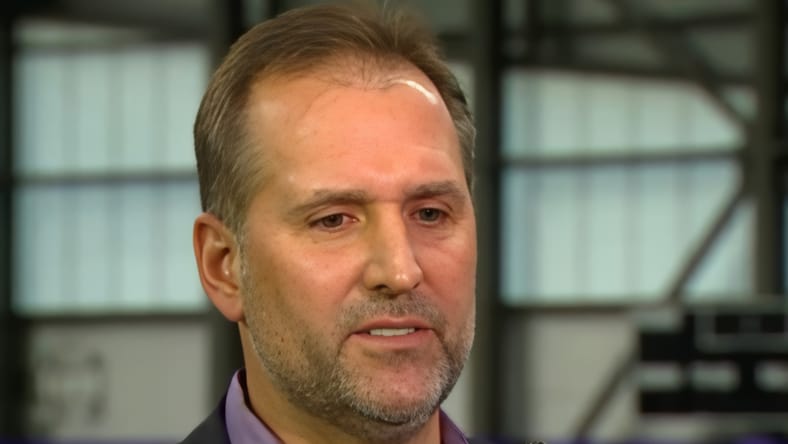
One might speculate that the Vikings’ decision to stick and pick reflects interim GM Rob Brzezinski’s aversion to risk: he didn’t want to trade back and risk losing Banks. The problem with this, however, is that the selection of Banks is itself an extremely risky proposition: his floor is nonexistent, as his foot injury could derail his entire career, and there is a very real possibility that he will end up as nothing more than a replacement for run-stuffer Harrison Phillips—the guy we just traded for sixth-round picks. To put it bluntly, the selection of Banks is a far bigger risk than moving back 5 spots would have been.
If the Vikings want to gamble, I’m all for it: as Brzezinski himself said after drafting Banks, “There’s nothing without risk.” Particularly when it comes to Super Bowls, fortune favors the brave.
But if that’s our strategy, let’s truly go for it: trade back, draft your high-upside lineman, and use the acquired picks to draft some other potential game-changers. I don’t need the Vikings to play it safe by sticking with the consensus. I just want to see them demonstrate a consistent identity, a commitment to gambling big in order to win big. So far, the new Vikings’ administration seems as lost and confused as they did with Kwesi Adofo-Mensah at the helm.