
The T.J. Hockenson Debate is Asking the Wrong Question

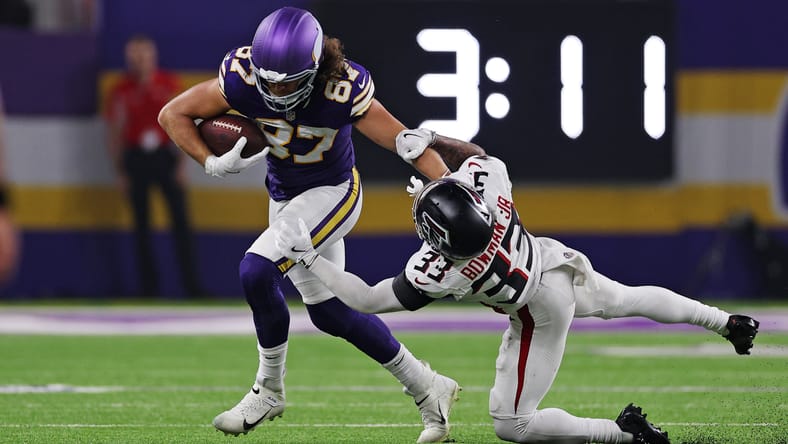
In T.J. Hockenson, the Vikings are employing a talented tight end who is overpaid. Few could argue otherwise. What’s far more fascinating is whether that will remain so.
Seeing the veteran continue to carry his $21,296,176 cap charge (per OTC) through 2026 is a non-starter for the cap-strapped Vikings. Something’s gotta give on that front, whether the savings arrive due to a cut, trade, or restructure (an extension appears supremely unlikely). The critical question is what Hockenson will go on to do rather than what he recently did.
T.J. Hockenson — The Real Question to Answer
The past is only helpful insofar as it functions as information to clarify the future.
Last year, T.J. Hockenson wasn’t good enough. The former No. 8 selection had his 51 receptions (66 targets) go for 438 yards and 3 touchdowns. The 8.1 yards-per-reception average is poor, lacking the game-changing explosiveness that teams want out of well-paid pass catchers. As a comparison, note that Johnny Mundt averaged 12.3 yards per reception (albeit within a smaller workload).
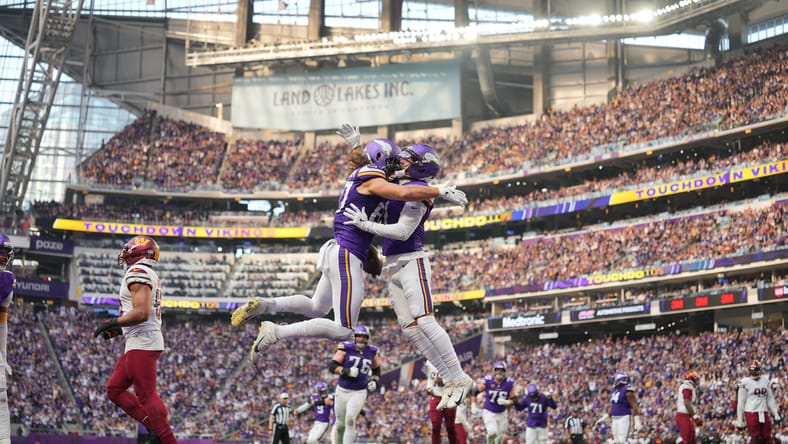
Also discouraging is that Hockenson isn’t much of a touchdown scorer. Nor, for that matter, is he much of a chain mover, only picking up 22 1st downs within his 51 catches. He’s improving as a blocker, but nobody thinks he’s the second coming of Jim Kleinsasser.
So, can the Vikings continue justifying Hockenson’s status the roster? The answer is a definitive yes as long as some factors get adjusted.
Start off with the cap charge.
Seeing close to $21.3 million chewed up by the tight end isn’t feasible. In theory, there could be an extension to clear out room, but that doesn’t look likely with his production declining coming off his serious knee injury in 2023 alongside his advancing age (he’ll be 29 in July). Scratch extension off the list of options since it’s so unlikely.
Rather, look toward a restructure for T.J. Hockenson. Pursuing the maximum savings would mean surpassing $9.4 million in added room for 2026. The cost of doing business is less cap space in the future, but that’s a problem for a different day. If Hockenson can be very good in 2026, then finding a way to make the cap charges work is the way forward.

Last year, Minnesota was held back partly due to the offensive line not being healthy. The TE1 who is paid to make catches had to block more than normal. That’s part of the problem.
Likewise, the quarterback spot wasn’t anywhere close to good enough. All of the pass catchers suffered from such a brutal effort from the team’s trio of passers — J.J. McCarthy, Carson Wentz, and Max Brosmer. Hockenson does deserve some grace since he can’t pass himself the ball.
If, in theory, a competent passer gets added (or, better yet, McCarthy turns into one), then the Vikings may be able to unleash a talent like T.J. Hockenson. Indeed, that’s the central question Minnesota is seeking to answer: can Mr. Hockenson be excellent in the future? That’s what’s interesting and pivotal.
Everybody can see that 2025 wasn’t enough. Where there’s some fascination is whether there will be production good enough to justify the pay for 2026 and moving forward.
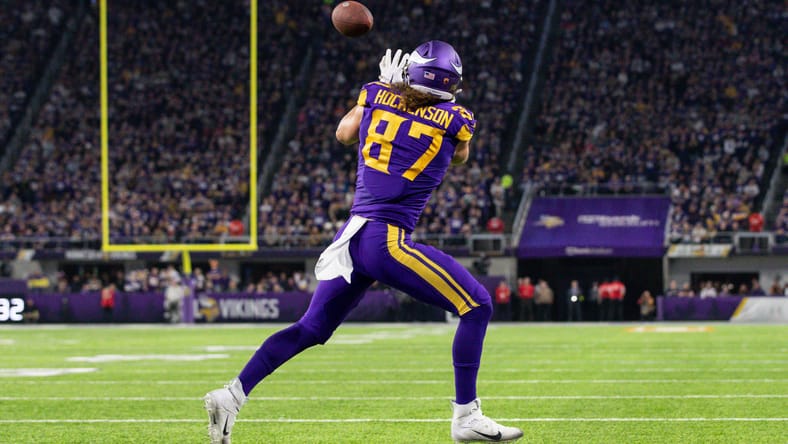
In 2026, the Minnesota Vikings are going to pursue a genuine effort to compete. Keeping the tight end could be part of the winning formula.
NFL free agency is less than two weeks away, putting a clear timeline on the Vikings’ cap crunch (the league budget has been solidified). The cuts, restructures, trades, and extensions get rolling in a matter of days.
