
Apparently, The Vikings were Oh-So-Close to Trading for a Hall of Fame LT1


For a little while, the understanding has existed that the Vikings tried and failed to trade for stud left tackle Trent Williams. Williams dug into that idea earlier in the week in a piece written by Nicki Jhabvala for The Athletic.
Within the article, Williams clarifies how things went down in the trade that never happened, setting the stage for what looked like an imminent move to Minnesota: “‘I was getting ready to go to Minnesota. It wasn’t my ideal place, but I was cool with it. I mean, I like Kirk (Cousins). Kirk’s one of my friends and I was ready to do it.'”
The Vikings Got Very Close on Trent Williams
Start off with a simple reality: ending up with Christian Darrisaw as the consolation prize is no reason to be upset. Just how far does Darrisaw have to go to match Williams?
Williams is the NFL’s preeminent left tackle. Few, if any, could debate as much. Essentially every left tackle wants to one day be as good as Williams in the same way that quarterbacks seek to be Tom Brady. Impossible, perhaps, but a lofty goal to fuel the fires of motivation. Williams has eleven Pro Bowl trips alongside being a three-time first-team All Pro and a second-team All Pro. He is, in short, a total stud who is a shoo-in to be a first-ballot Hall of Fame selection.

Circle back around to catch up on Williams.
Jhabvala offers some context to set the table: “In March 2020, two months after Washington hired Ron Rivera as head coach, the team agreed to let Williams and his agent seek a trade. He was dealt to the 49ers during the draft that year for a 2020 fifth-round pick and a 2021 third-rounder” (italics in original).
And then Williams giving his take: “‘I was getting ready to go to Minnesota. It wasn’t my ideal place, but I was cool with it. I mean, I like Kirk (Cousins). Kirk’s one of my friends and I was ready to do it. And then when I saw the compensation and it was like two fifth-rounders, I’m like, ‘Oh well, that’s not a steep price.’”
Further from the left tackle: “‘So I said to (49ers coach) Kyle (Shanahan), ‘Hey man, I’m finna go to Minnesota. What’s up?’ I forget exactly how I put it. And he was like, ‘No, man, no. The asking price (Washington) wants is too high. It’s astronomical. They’re gonna want a couple of first-rounders.’ I said, ‘No, I’m literally finna get traded for two fifth-round picks.’ And he was like, ‘What?’ Then he got in the mix and then the Rams got in the mix, and, obviously, I’ve known (Rams coach) Sean McVay just as long as I’ve known Kyle.'”
The Rams option was considered, but the possibility of being shuffled into left guard — Andrew Whitworth was the left tackle, who was tremendous — wasn’t particularly appealing.
The final word from Williams: “‘So I kind of zeroed in on the 49ers and we made it work. (The Rams) came back and was like, ‘No, we’re going to let you play left tackle.’ Whitworth contacted me himself and said he’d love to play with me. But at that point, it was kind of a little too far — I’d already taken my mind off of them and I was doing whatever I could to get to San Francisco.'”
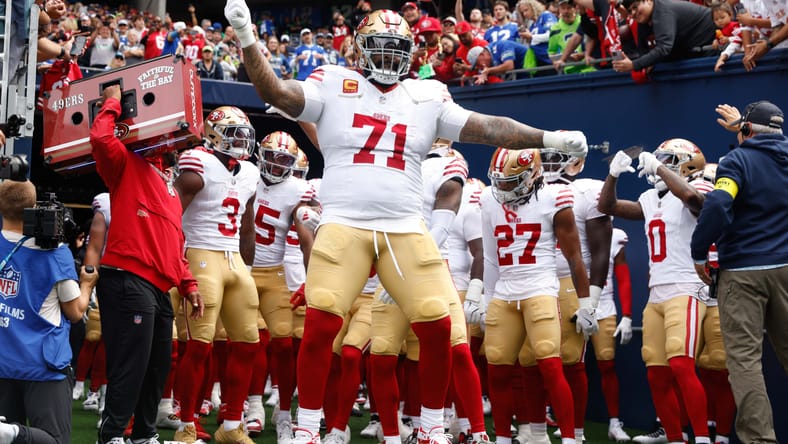
First, a quick word on the article itself.
Credit to Nicki Jhabvala. Giving the microphone to players who know what it’s like to be traded is a great move. Making an effort to highlight the humanity of players is excellent stuff and should be kept in mind even as fans and writers enjoy the chaos of the trade deadline.
As things relate to the Vikings, it’s easy to see the appeal of Trent Williams. Back in 2020, the Vikings could have really used someone as magnificent as Williams (doesn’t every team want an elite left tackle?). The Mike Zimmer era was often beset by poor play along the offensive line, so handing over modest draft picks for Mr. Williams would have been a sensational trade.
In the end, San Francisco landed the LT1. Meanwhile, Minnesota is moving ahead with Darrisaw, someone who has the potential to become elite. Someday, perhaps, Darrisaw could be mentioned alongside Williams as being among the great linemen of the twenty-first century.
