
Already Cash Strapped, The Vikings’ Money Situation is Soon to Grow Worse

The Vikings’ money situation has been an ongoing issue. Such is the consequence of spending so freely and aggressively during this past March.
Even worse, of course, is that the regular season hasn’t gone particularly well. The one position that was uniquely equipped to sink a season — quarterback — sunk the season (though the head coach shoulders some blame). Freshly eliminated from the playoffs, the Vikings will need to conquer a debt pile that’s going to get worse before it gets better.
The Vikings’ Money Situation as 2026 Approaches
The update arrives courtesy of Jason Fitzgerald, the mastermind of NFL salary cap website Over the Cap.
The word: “Here is how the teams eliminated and virtually eliminated from the playoffs stack up in cap space (includes futures signings) and draft capital in 2026. For reference average cap is $19.7M and draft value is 5,520.” Below is an image of a chart listing the Vikings with a projected $46.6 million in upcoming debt to digest alongside draft picks that add up to 5,792.
So, that’s cap space that’s way below average (terrible, in fact) alongside slightly-above average draft resources.

The good news is that Minnesota has long been preparing for the issue. The complicating issue is that long-rumored cut candidates — one thinks of center Ryan Kelly and tight end T.J. Hockenson as a pair of examples — have been playing better.
Let’s assume, though, that there is a solution. Better yet, let’s consider just one plausible path.
Start off with Justin Jefferson, the team’s best player who has been the subject of much speculation, curiosity, anxiety, and rumors. Maybe kicking over some added compensation will play a role in keeping him happy in the Twin Cities. A restructure could clear out more than $18 million while an extension could clear out $19 million. Let’s assume, though, that the maximum savings aren’t sought, instead arriving at a cool $10 million.
Meanwhile, right tackle Brian O’Neill is heading into his final season under contact. Any chance that extending the excellent lineman — albeit one with some health issues in 2025 — arrives? He could see $14 million shaved off with an extension.
Again, though, let’s go ahead and put things at $10 million, meaning there’s $20 million in freed up cap space.
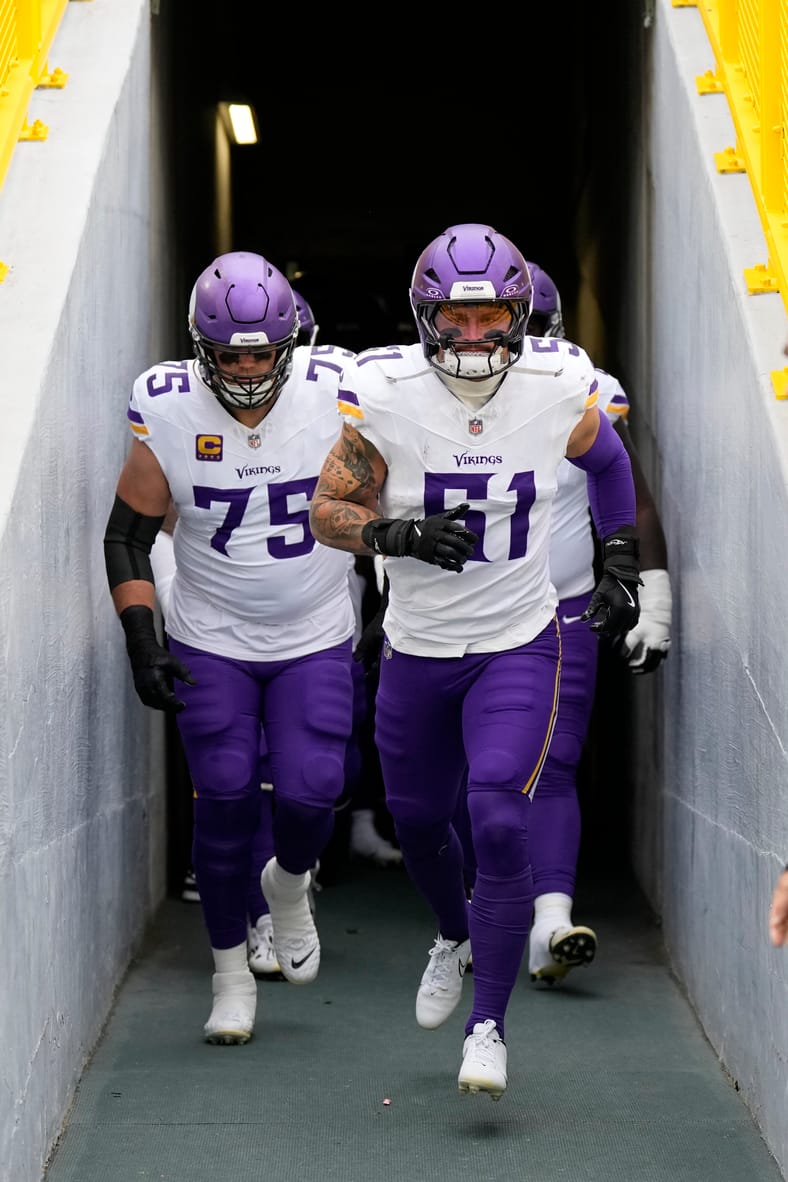
There’s then some others moving into their finals seasons under contract. All of LB1 Blake Cashman, C1 Ryan Kelly, RB2 Jordan Mason, and CB2 Isaiah Rodgers are moving into contract seasons. After rounding down, these players could see the LB1 free up $4 million, the C1 free up $5 million, the RB2 free up $2 million, and the CB2 free up $2 million.
In no example listed above are the maximum savings pursued. Instead, the proposed extensions would involve a total boost of $13 million to the Vikings’ money. Combined with the proposed savings from Jefferson and O’Neill, that’s $33 million carved out.
Keep in mind, as well, that carryover money can function as a pressure-release valve for the finances. Dollar saved, dollar earned.
So, the path forward isn’t entirely impossible (dig into Spotrac for a slightly different version of the numbers). There’s currently north of $15 million in open cap space alongside $33 million discussed here through no cuts or trades, only restructures and extensions. Those two numbers sit at $48 million, more than enough to clear out the forecasted debt.
Next up for the cash-stepped Vikings is a Sunday game against the Giants.
